- Your cart is empty
- Continue Shopping
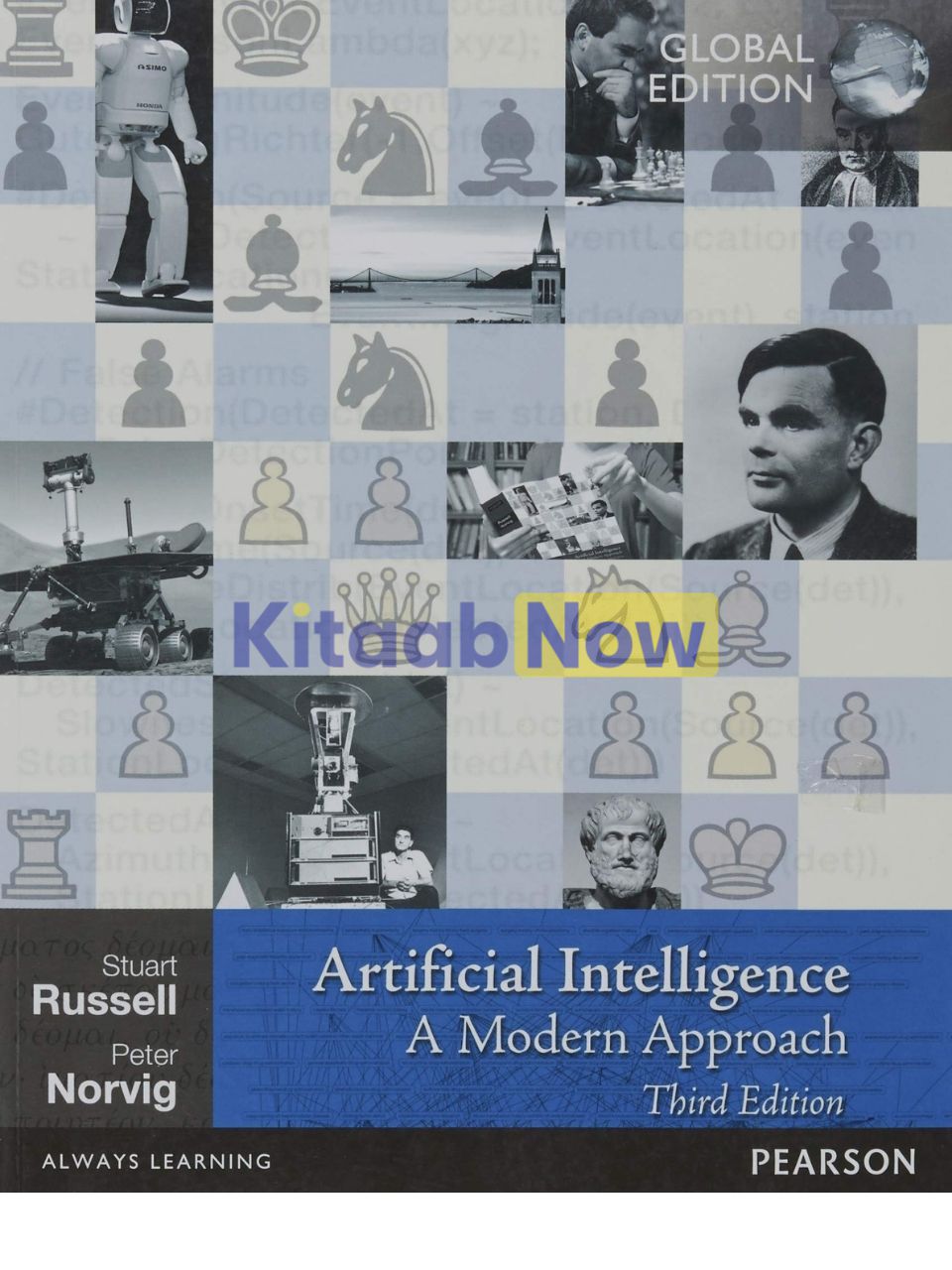
Artificial Intelligence: A Modern Approach (3rd Global Edition)
44% off
DescriptionFor one or two-semester, undergraduate or graduate-level courses in Artificial Intelligence.The long-anticipated revision of this best-selling text offers the most comprehensive, up-to-date introduction to the theory and practice of artificial intelligence.Key FeaturesNontechnical learning material.Provides a simple overview of major concepts, uses a nontechnical language to help increase understanding. Makes the book accessible to a broader range of students.The Internet as a sample application for intelligent systems — Examples of logical reasoning, planning, and natural language processing using Internet agents.Promotes student interest with interesting, relevant exercises.Increased coverage of material — New or expanded coverage of constraint satisfaction, local search planning methods, multi-agent systems, game theory, statistical natural language processing and uncertain reasoning over time. More detailed descriptions of algorithms for probabilistic inference, fast propositional inference, probabilistic learning approaches including EM, and other topics.Brings students up to date on the latest technologies, and presents concepts in a more unified manner.Updated and expanded exercises — 30% of the exercises are revised or NEW.More Online Software.Allows many more opportunities for student projects on the web.A unified, agent-based approach to AI — Organizes the material around the task of building intelligent agents.Shows students how the various subfields of AI fit together to build actual, useful programs.Comprehensive, up-to-date coverage — Includes a unified view of the field organized around the rational decision making paradigm.A flexible format.Makes the text adaptable for varying instructors’ preferences.In-depth coverage of basic and advanced topics.Provides students with a basic understanding of the frontiers of AI without compromising complexity and depth.Pseudo-code versions of the major AI algorithms are presented in a uniform fashion, and Actual Common Lisp and Python implementations of the presented algorithms are available via the Internet.Gives instructors and students a choice of projects; reading and running the code increases understanding.New to this EditionThis edition captures the changes in AI that have taken place since the last edition in 2003. There have been important applications of AI technology, such as the widespread deployment of practical speech recognition, machine translation, autonomous vehicles, and household robotics. There have been algorithmic landmarks, such as the solution of the game of checkers. And there has been a great deal of theoretical progress, particularly in areas such as probabilistic reasoning, machine learning, and computer vision. Most important from the authors’ point of view is the continued evolution in how we think about the field, and thus how the book is organized. The major changes are as follows:More emphasis is placed on partially observable and nondeterministic environments, especially in the non-probabilistic settings of search and planning. The concepts of belief state (a set of possible worlds) and state estimation (maintaining the belief state) are introduced in these settings; later in the book, probabilities are added.In addition to discussing the types of environments and types of agents, there is more in more depth coverage of the types of representations that an agent can use. Differences between atomic representations (in which each state of the world is treated as a black box), factored representations (in which a state is a set of attribute/value pairs), and structured representations (in which the world consists of objects and relations between them) are distinguished.Coverage of planning goes into more depth on contingent planning in partially observable environments and includes a new approach to hierarchical planning.New material on first-order probabilistic models is added, including open-universe models for cases where there is uncertainty as to what objects exist.The introductory machine-learning chapter is completely rewritten, stressing a wider variety of more modern learning algorithms and placing them on a firmer theoretical footing.Expanded coverage of Web search and information extraction, and of techniques for learning from very large data sets.20% of the citations in this edition are to works published after 2003.Approximately 20% of the material is brand new. The remaining 80% reflects older work but is largely rewritten to present a more unified picture of the field.Table of Contents Part I. Artificial IntelligenceIntroductionIntelligent AgentsPart II. Problem-solvingSolving Problems by SearchingBeyond Classical SearchAdversarial SearchConstraint Satisfaction ProblemsPart III. Knowledge, Reasoning, and PlanningLogical AgentsFirst-Order LogicInference in First-Order LogicClassical PlanningPlanning and Acting in the Real WorldKnowledge RepresentationPart IV. Uncertain Knowledge and Reasoning13. Quantifying UncertaintyProbabilistic ReasoningProbabilistic Reasoning over TimeMaking Simple DecisionsMaking Complex DecisionsPart V. Learning18. Learning from ExamplesKnowledge in LearningLearning Probabilistic ModelsReinforcement LearningPart VI. Communicating, Perceiving, and Acting22. Natural Language ProcessingNatural Language for CommunicationPerceptionRoboticsPart VII. ConclusionsPhilosophical FoundationsAI: The Present and FutureMathematical BackgroundNotes on Languages and AlgorithmsBibliographyIndexAuthor BiographyStuart Russell is a professor of Computer Science and holder of the Smith-Zadeh Chair in Engineering at the University of California, Berkeley, where he also directs the Center for Human Compatible Artificial Intelligence. He is an Honorary Fellow of Wadham College, University of Oxford and the vice-chair of the World Economic Forum’s Council on AI and Robotics. His work for the UN building a new global seismic monitoring system for the Comprehensive Nuclear-Test-Ban Treaty has been recognized by the Feigenbaum Prize of the Association for the Advancement of Artificial Intelligence. He has been an invited speaker at TED, the World Economic Forum, and the Nobel Dialogues in Stockholm and Tokyo. He is the author (with Peter Norvig) of Artificial Intelligence: A Modern Approach, the number one bestselling textbook in AI which is used in over 1,400 universities in 128 countries. He was born in England and lives in Berkeley and Paris.